Carbon deposits in thawing permafrost include widely reported methane gases released as bubbles and present in craters across Siberia. Scientists wanted to find out more about the greenhouse emissions and what was in the defrosted ground ice including dissolved organic matter (DOM) and particulate organic matter (POM).
They studied four locations across the Russian arctic including northwest, Siberia and an archipelago. They used deep ice cores, digging up to 12 metres below the surface, comparing different eras including late Pleistocene and Holocene as well as recent Arctic icing.
They collected 78 samples from across all four sites. In some cases the tabular ground ice was over 4.5 metres with the top layers containing sediment, mollusc shells, sand, silt and pebbles whilst lower layers were just ice:
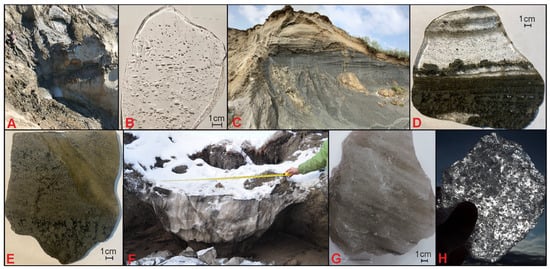
They then compared their samples with glacier ice from the 2300 km2 Leningradsky glacier on the archipelago. The ice samples were weighed and sent for compounds analysis using thawed water from the ice. They also used ion and gas chromatography for the chemical analysis. They tested fluoresence using a technique known as PARAFAC modelling then compared the results with statistical analysis.
They found that DOM varied across all samples including bogs, wetland and tundra ground ice. They found high methane concentrations in recent years but also some of the late Pleistocene years. They believe this is partly due to being present in the water but also more favourable environmental conditions in the tundra. They think impure tabular ground ice and Siberian ice wedges contribute more directly to methane emissions. Using fluoresence found a link between dissolved organic carbon (DOC) and DOM, with carbon affected by enzymatic processing and microbial biomass.
Overall they think that DOM interacting with soil, detritus and vegetation enriches the ground ice with carbon. They believe that further research including genetic analysis between different ice types will help scientists understand what is most likely to create greenhouse gas emissions.
Semenov P, Pismeniuk A, Kil A, Shatrova E, Belova N, Gromov P, Malyshev S, He W, Lodochnikova A, Tarasevich I, et al. (2024), Characterizing Dissolved Organic Matter and Other Water-Soluble Compounds in Ground Ice of the Russian Arctic: A Focus on Ground Ice Classification within the Carbon Cycle Context. Geosciences; 14(3):77. https://doi.org/10.3390/geosciences14030077

 Russian Climate Research