Heartwood (HW) has a major proportion of a tree trunk, compared with its outer sapwood (SW). Researchers investigated the carbon accumulation to understand the depths of carbon sequestration in pine species in north-western Russia. They mentioned that 64% of the forests of Russian Karelia are Scots Pine which they compared across lingonberry (30% Karelia, 42% Murmansk), blueberry and lichen pine species. They chose plots from the Forest Research Institute of the Karelian branch of the Russian Academy of Sciences.
They selected plots based on soil quality, ground vegetation cover and stand productivity. Whilst lichen is not well studied in Karelia, lingonberry and blueberry have greater productivity than lichen which can grow in poor, dry soil. They investigated age of core samples, tree growth and count and woody debris, comparing with non-pine species. They performed biochemical analysis of the samples in a lab. Additional analysis including converting biomass calculations into carbon. They then used PAST 4.0 for statistical analysis comparing based on climate, social class and wood tissue. They found that:
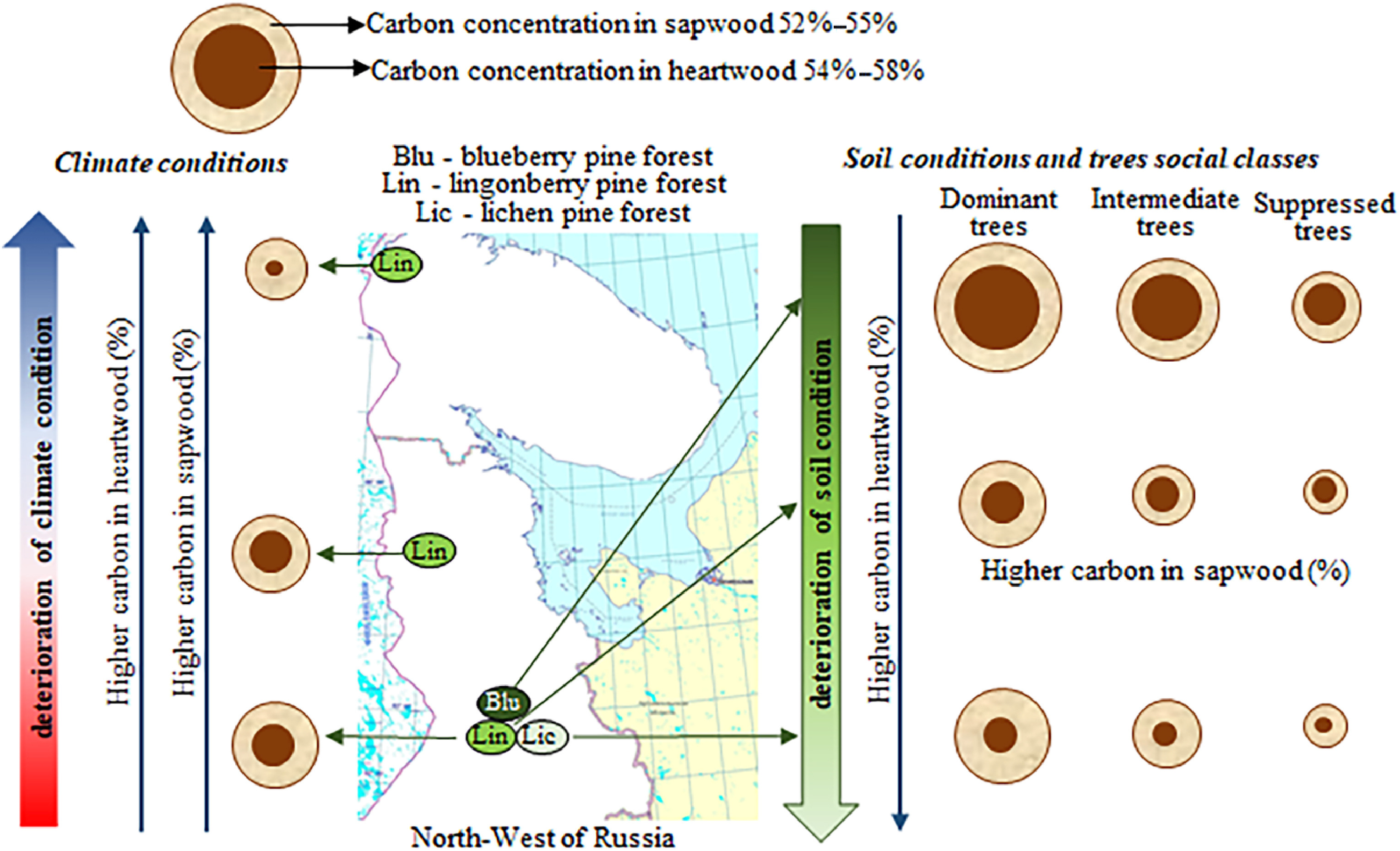
for 80-year-old pine trees the carbon concentration in SW and HW was 52%–55% and 54%–58%, respectively. We studied the relationships between carbon concentration and extractives, cellulose, and lignin contents in HW and SW of pine trees. We have shown that these relationships were ambiguous and varied in different soils, climate conditions, and the position of the tree in the stand (social class). In general, both the HW proportion on tree trunks, and the carbon concentration in SW and HW influence on carbon storage in pine stands.
Galibina et al., (2024) Assessment of the heartwood contribution to carbon accumulation in Pinus sylvestris L. trees under different forest site conditions. Forest Ecosystems, [online] 12, p.100274. doi:https://doi.org/10.1016/j.fecs.2024.100274
For heartwood trunk formation they found trees adapt based on water stress:
…the deterioration of climatic conditions (transition area of the northern taiga subzone and tundra compared to the middle taiga subzone) was accompanied in dominant trees by a decrease in the HW proportion in the trunk.
Galibina et al., (2024) Assessment of the heartwood contribution to carbon accumulation in Pinus sylvestris L. trees under different forest site conditions. Forest Ecosystems, [online] 12, p.100274. doi:https://doi.org/10.1016/j.fecs.2024.100274
…In blueberry pine forest, we did not find any differences in the HW proportion in the trunk depending on the social class trees. Suppressed trees in lingonberry pine forest, and especially intermediate and suppressed trees in lichen pine forest had the higher HW proportion in the trunk. So, deterioration in growing conditions activated the HW formation in intermediate and suppressed trees.
Overall their research data estimates 3% higher carbon concentration in heartwood compared with sapwood. The proportion of heartwood of heartwood is approximately 20-30% in lingonberry and over 50% blueberry pines that are between 70-80 years old. They suggest this is due to deteriorating growing conditions e.g. from climate factors.
Galibina, N.A., Nikerova, K.M., Moshnikov, S.A. and Kryshen, A.M. (2024). Assessment of the heartwood contribution to carbon accumulation in Pinus sylvestris L. trees under different forest site conditions. Forest Ecosystems, [online] 12, p.100274. doi:https://doi.org/10.1016/j.fecs.2024.100274

 Russian Climate Research