Affected by ice free seas, polar bears are increasingly visiting human villages and adding human waste to their diet. So what are Russian Arctic bears eating? Researchers decided to analyse bear poo to measure natural vs human waste sources of food.
Arctic sea ice melt has left polar bears unable to feed on their natural food and stay on shore longer which drives them into human villages in search of food. However this may give them diet and metabolic diseases or virus exposure.
The researchers expected to find changes in bear gut microbiome. They chose 3 archipelago sites to analyse – Franz Josef Land and two sites of Novaya Zemlya. They collected samples from Franz Josef at the beginning of the seasonal ice melt and Novaya Zemlya during the ice melt. They observed the bears with satellite data for a few days beforehand then immobilised bears so they could collect the samples. They measured sex, body mass as well as time, temperature and other environmental measures. They recorded observations such as fat deposits and observable health condition.
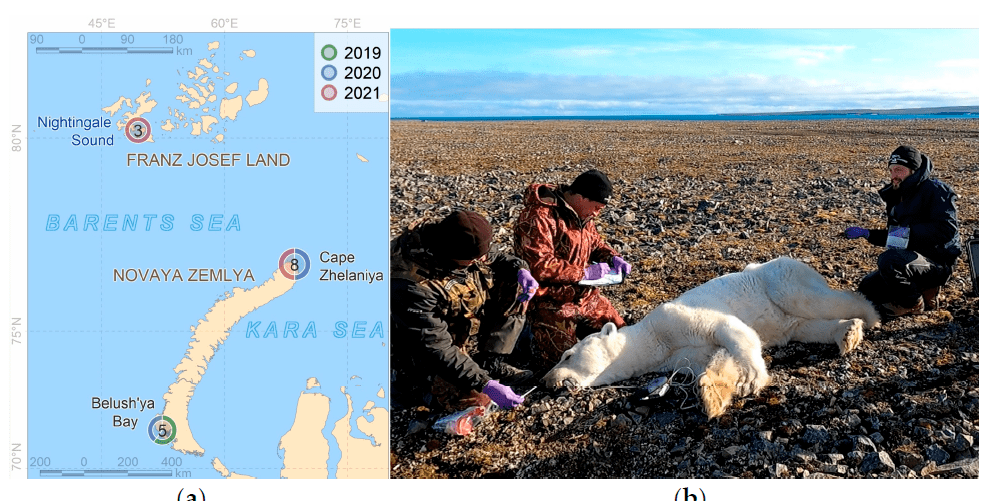
Land polygons for the basemap (a) are from “Data Derived from OpenStreetMap for Download”
They collected the poo from bear rectums with gloves, then prepared the bears for recovery from the anaesthetic. The samples were in a freezer (-18 C or below) within an hour. They isolated the fecal DNA then analysed microbial behaviour using specialist labs in St Petersburg. They completed statistical analysis to capture differences across bear microbiomes. Bears varied in sex, age and weight.
They didn’t find any significant patterns between age, sex and microbiome composition, however they did notice some increases in the diversity of gut microorganisms. They did not find microorganisms which are common in marine mammals. They found more complex carbohydrates common to human waste alongside a decrease in proteins and fat. They suggest that yeasts will increase with more colonisation through digestion of human waste.
Vecherskii, M. V. et al. (2023) Anthropogenic Neighborhood Impact on Bacterial and Fungal Communities in Polar Bear Feces. Animals. [Online] 13 (13), 2067-.https://browzine.com/libraries/2269/articles/575930716

 Russian Climate Research
One Comment Add yours