Research has shown that there is an accumulation limit for organic carbon in Chernozem (black) soils, resulting in carbon emissions once that limit has been reached. Agricultural management practices can include crop rotation, fallowing, residue management and fertilisation to counter the less carbon-rich soils as they arise.
The researchers previously studied a 40 year period until 2020 of chernozem soils in the Rostov region. As a follow-up they have simulated prospects up until 2090. They wanted to understand whether organic carbon input can be naturally increased with crop rotation or whether additional fertiliser is needed, based on predicted climate change.
They used data from the Long Term Field Experiment (LTFE) launched in 1974 by the Federal Rostov Agricultural Research Center, on a Rostov plateau about 20 km from the Don River. Crops include black fallow, winter wheat, mazie, barley, peas and sunflowers. To simulate climate changes, they used variables for temperature, precipitation and evotranspiration effects. They calculated carbon accumulation and emissions based on predicted yields including data from RosHydromet. They found an overall decrease in organic carbon using crop rotations with no additional fertilisers:
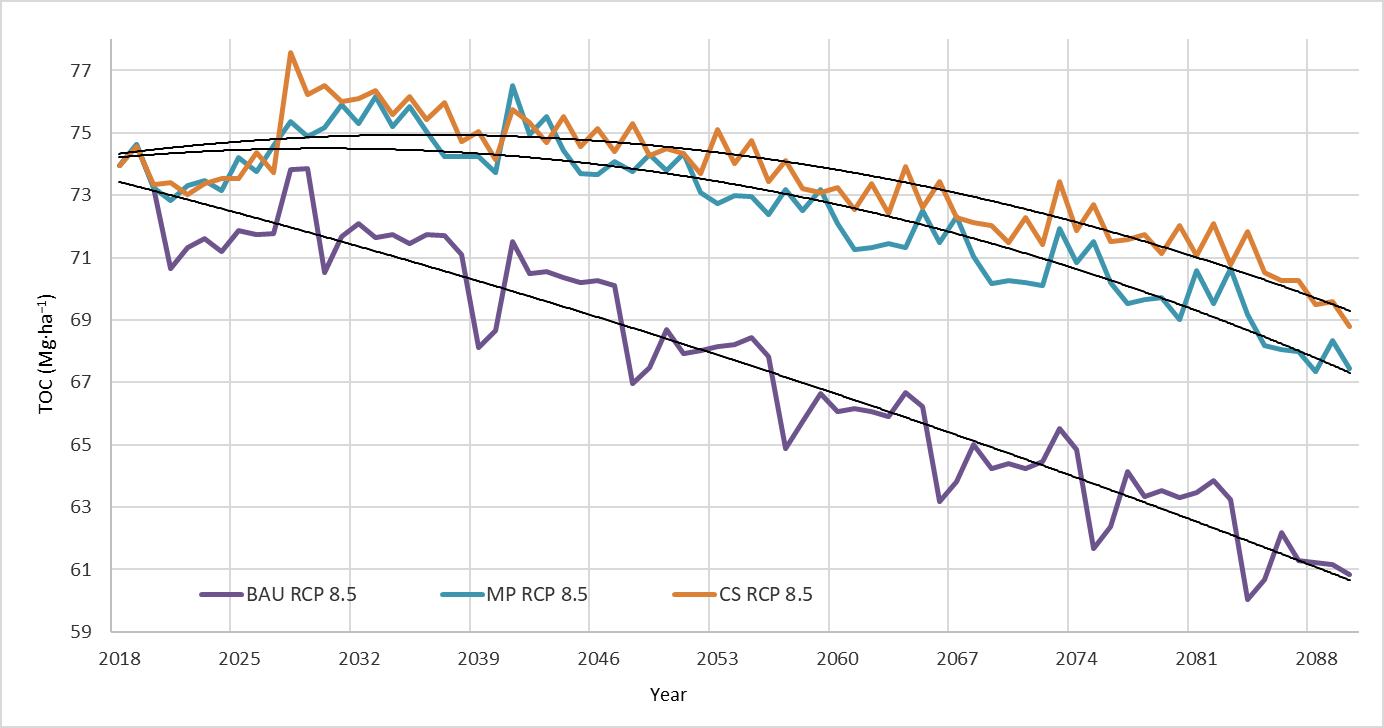
model for 2018–2090 in the control treatment under the RCP4.5 (a) and RCP8.5 (b) climate change
scenarios. , Husniev et al., 2023.
With fallow yield management and no additional fertilisers also shows a decline, althought some stocks retain similar levels:
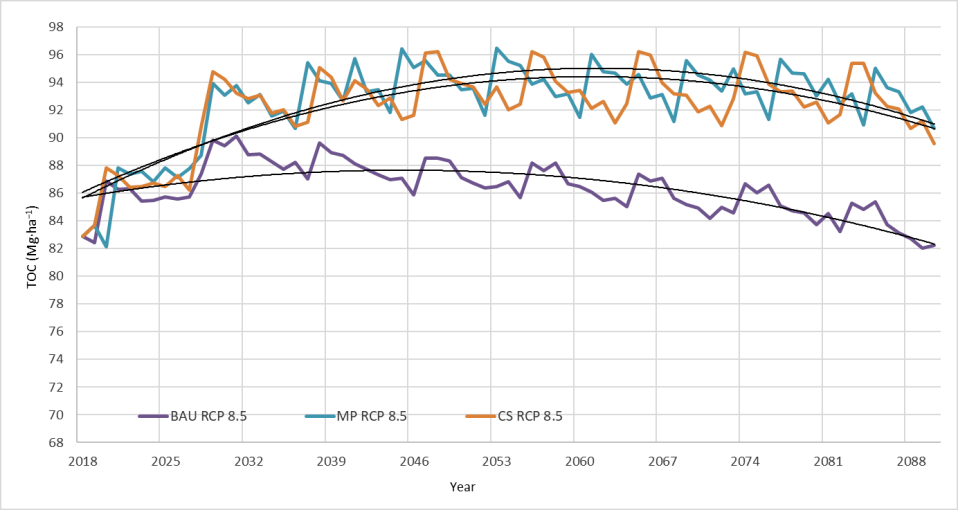
model for 2018–2090 in treatment 11 in RCP8.5 climate scenarios, with application of FYM (c), Husniev et al., 2023.
Amount of additional organic carbon needed to maintain stocks:

increase of 4‰ annually in SOC stocks in 2055 (a) and 2090 (b), Husniev et al., 2023.
Overall the decline is slower during the later part of the century, potential due to predicted climate conditions. With a combination of crop rotation and fallow yield management this could potentially be managed in the RCP4.5 scenarios, but not in the RCP8.5 scenarios so additional organic fertilisation would be required, assuming no other climate change, changes in agricultural technologies or other impacts. They recommend a climate adaptation scenario including organic mineral fertilisation (e.g., through manure), based on the modelling.
Husniev, I., Romanenkov, V., Siptits, S., Pavlova, V., Pasko, S., Yakimenko, O. and Krasilnikov, P., 2023. Perspectives on Effective Long-Term Management of Carbon Stocks in Chernozem under Future Climate Conditions. Agriculture, [online] 13(10), p.1901. https://doi.org/10.3390/agriculture13101901

 Russian Climate Research
One Comment Add yours