
All six countries have strategies towards achieving carbon neutrality. The researchers report that they have 44% of global population, 39.2% global GDP, 44.8% primary energy consumption and 49% global CO2 emissions.
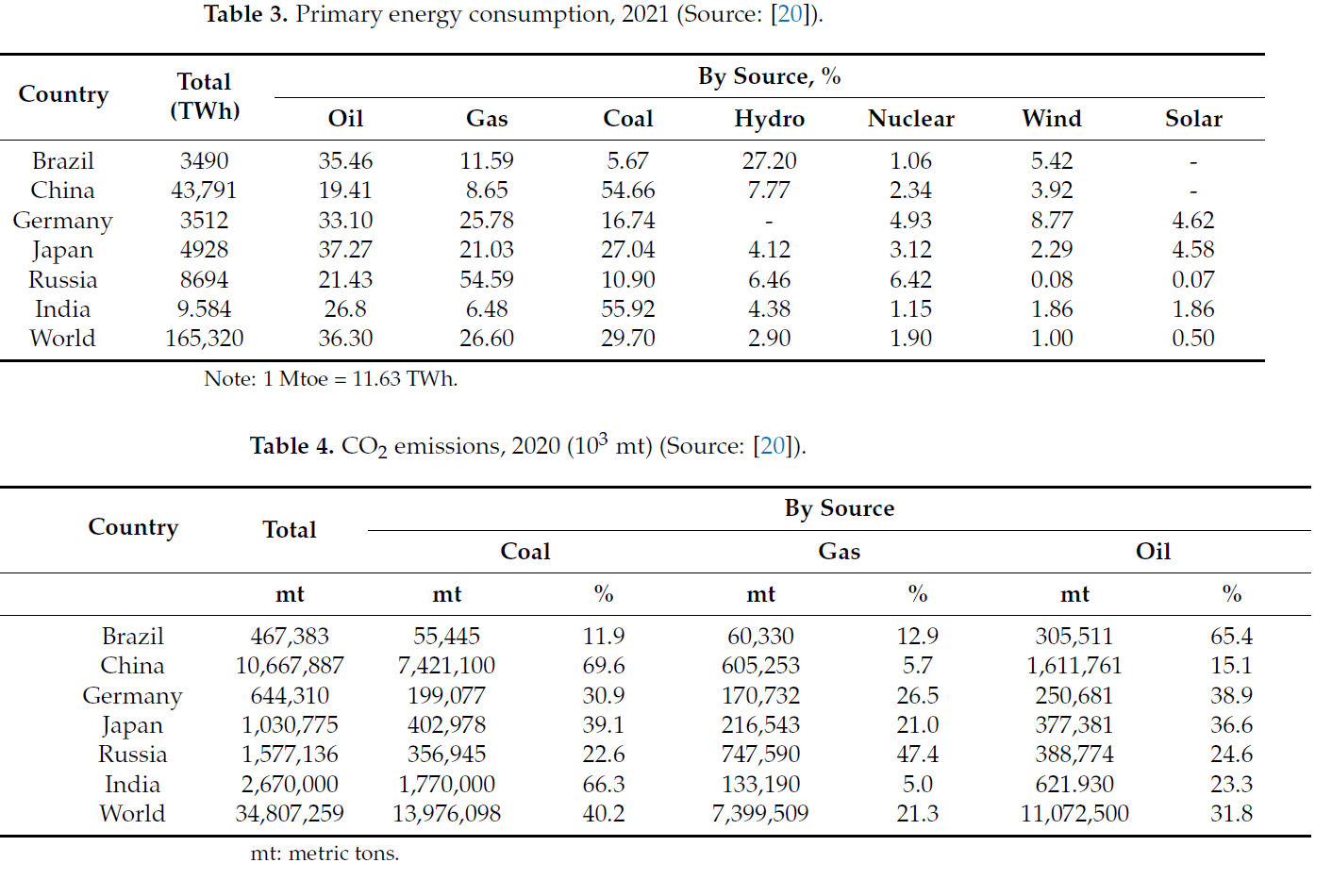
They note that different views on economic development and energy transition affect an overall international climate outlook from agreements such as Paris 2015. They wanted to find out whether low-carbon economic development was possible in each country and what energy policies and conditions are necessary for enablement.
They used correlation analysis and quantitative forecasting methods for growth of renewable technologies including factors such as time and seasonality. They added investment data between 2004-19, excluding Russia because their data is not sufficient for modelling purposes, partly due to sanctions. They forecasted that Brazil which already has high rates of renewables, will have the highest share of electricity generation from solar and wind by 2032, with over 85%, then Russia, China, Germany between 36-57%, and Japan and India both under 30%. Russia is slowly increasing but overall is low because hydropower and nuclear are their highest renewable investments. Japan was affected by Fukushima. China and Germany have higher levels of electric vehicle sales (cars).
For specific data and forecasting, Tick et al, 2024, go into great detail. Some national economic considerations for growth include:
- Brazil with high amounts of sugar cane, used for biomass and also bioethanol for creating liquid biofuels.
- China with lithium-ion batteries, UHV transmission
- Germany’s geopolitical tensions affecting energy consumption and generation
- Japan’s investments with hydrogen
- Russia’s nuclear technologies, also forest carbon capture assessment
- India’s existing solar and wind capacity against potential demand and plans for CCS.
Overall India, Germany and China have the most ambitious goals with Russia and Brazil at a lower pace and lower investment in renewable technology, and Japan also at a lower pace but higher investment in renewables. The researchers note that investment in both hydrogen and nuclear for decarbonising will also remain popular, alongside increasing solar and wind availability.
Tick, Andrea, Askar Akaev, Tessaleno Campos Devezas, Askar Sarygulov, Alexander Petryakov, and Anufriev Igor Evgenevich. 2024. “Assessing Decarbonization Approaches across Major Economies” Energies 17, no. 17: 4381. https://doi.org/10.3390/en17174381

 Russian Climate Research